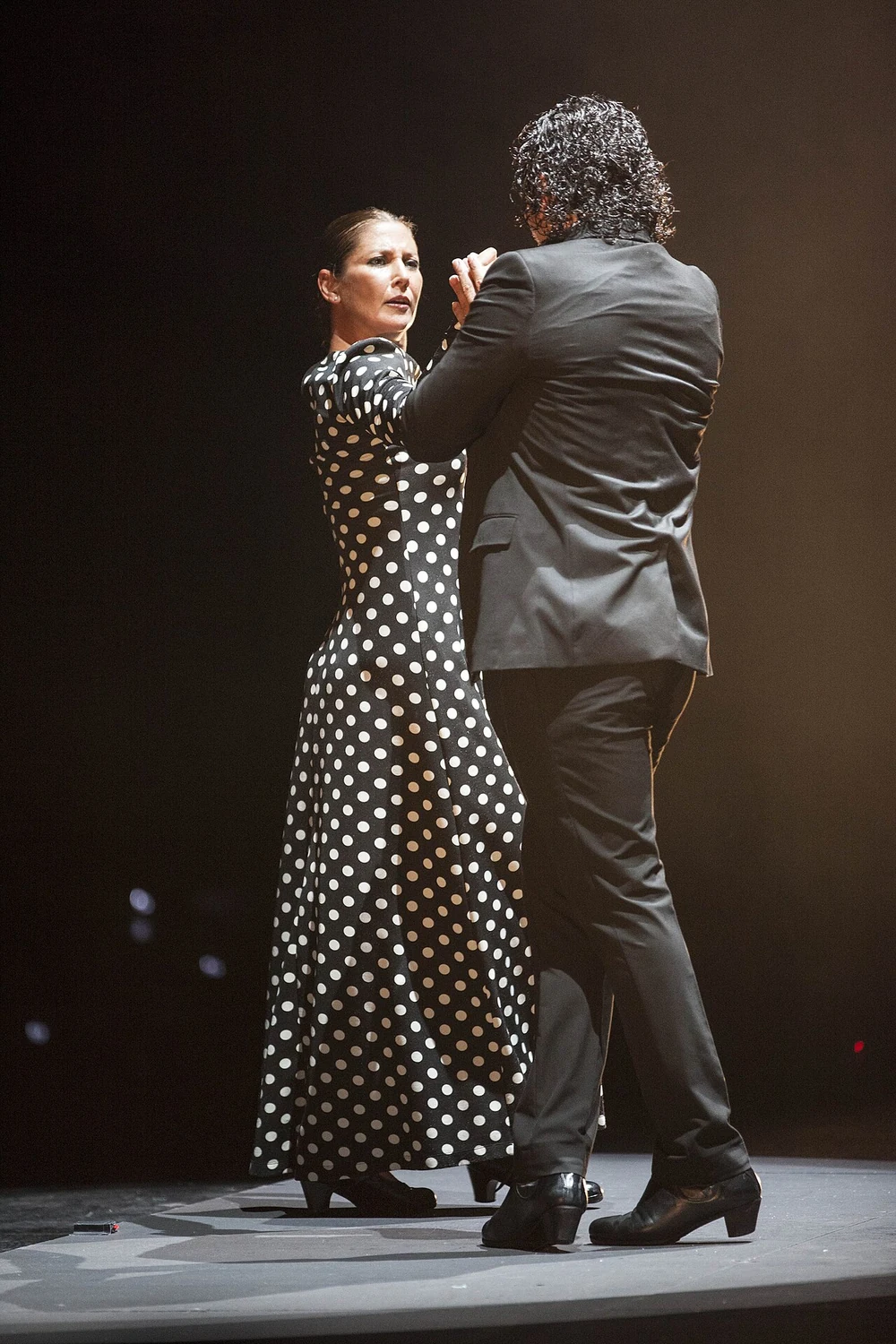
Dance, choreography and a Cádiz beginning
Born in Cádiz province in 1971, Sara Baras began learning dance with her mother, Concha Baras. Her professional path included work with Manuel Morao before the creation of her own company. That background connects her biography with a flamenco environment in Andalusia, while the career that followed took her work onto international stages.
She is a dancer, choreographer and artistic director. Her name identifies both the performer you hope to see and the person shaping the production. Dance is the starting point, while music, other dancers, lighting and costumes contribute to the idea bringing the evening together.
A company and a body of work
Her company made its debut in 1998 with Sensaciones. Forming a company gave Baras a framework for developing productions around her own artistic direction. Spain's National Dance Award followed in 2003, and an Olivier Award in 2020 marked further recognition of her work. These milestones locate a career built across many productions and successive audiences.
Earlier titles such as Juana la Loca and Mariana Pineda show her interest in giving a theatrical project a particular subject. For a visitor, this is a useful distinction: A named production has its own identity and dramatic structure. Discovering Baras means following how that structure changes across her work, as well as watching her individual dancing.
What her work brings into view
Baras offers an introduction to flamenco as a choreographic art. A sequence can have an individual dancer at its centre, then widen to a group, return to the musicians or move into another part of a production. The scale of a company lets those relationships become part of the stage design rather than a single uninterrupted solo.
Watch with your ears as well as your eyes. Footwork contributes sound; the singer carries another strand; the guitar can respond to movement or open a passage. Following the musical focus helps you follow the company, while leaving room to enjoy an image or gesture without explaining it immediately.
Vuela: A tribute to Paco de Lucía
Vuela pays tribute to Paco de Lucía and was created in connection with the company's twenty-fifth anniversary. Its fifteen pieces form four acts, named Madera, Mar, Muerte and Volar. Baras is responsible for direction and choreography, with music and adaptations of Paco's work by Keko Baldomero. The production connects a guitarist's legacy with the language of dance.
The published programme gives several musical doorways into that idea, including minera, soleá, tangos and bulería. It even identifies a zapateado shared by Baras and Baldomero. For a first encounter, follow how footwork and guitar occupy the same musical space. The tribute's structure provides a wider context than expecting an evening of familiar guitar tunes.
Infinita: Andalusia as a stage subject
Infinita takes another starting point: Eight women embody the eight provinces of Andalusia. The official description brings flamenco into relation with folklore, using music, dance, costume and lighting to shape that journey. Geography becomes material for a production, opening a different route into Baras's work from Vuela's portrait of a fellow artist.
For someone planning an Andalusian trip, the idea invites curiosity about the region's variety. It is an artistic interpretation of place, rather than a catalogue of everything a province contains. Watch how a change of grouping, movement or musical setting marks a new passage. You can follow that progression without trying to identify every reference on a first viewing.
Seeing her work during a journey
Baras is an active artist, and her official La Gira page is the starting point for finding an announced performance. Follow the listing through to the theatre or festival selling that particular event. Choosing the production matters: Vuela and Infinita have different subjects, so knowing the title makes the visit more personal before the curtain rises.
A company production can complement a smaller flamenco evening. In a theatre, the stage picture and progression of the work become part of the experience; at a tablao, proximity brings attention towards exchanges between performers. Seeing both formats gives a trip different perspectives on music and dance.
Questions before you go
Is Sara Baras a dancer or a choreographer?
Both. She dances, creates choreography and directs her own company.
Where can I find her performances?
Her official La Gira page links announced events; use the relevant theatre or festival for that performance.