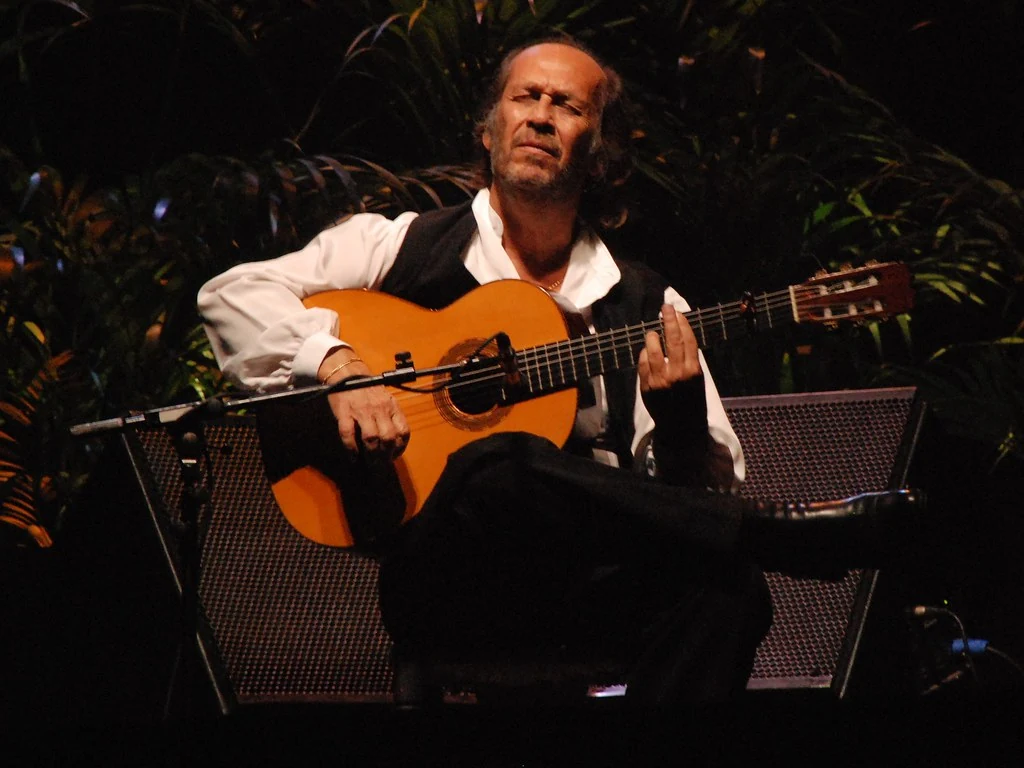
A guitarist from Algeciras
Paco de Lucía was the artistic name of Francisco Sánchez Gómez, born in Algeciras, Cádiz, in 1947. He became a central figure in the international recognition of flamenco guitar, as an accompanist, soloist and composer. He died in 2014, leaving a recorded legacy that continues to connect listeners with the musical life of southern Spain.
His story begins with the guitar as a family practice. For a visitor who associates flamenco mainly with dance, Paco offers another entrance: An instrument can carry a complete musical argument, while also supporting a singer or sharing a rhythm with other players.
From accompaniment to the concert stage
His collaboration with Camarón de la Isla linked two careers that are best understood together. Their records make voice and guitar partners in the development of a musical language. Paco also built a solo career, formed his sextet in 1981 and received Spain's Prince of Asturias Award for the Arts in 2004.
There was a wider musical conversation, too. His encounters with guitarists such as John McLaughlin and Al Di Meola brought flamenco into contact with jazz musicians and international concert audiences. These collaborations help explain why his name appears in several musical worlds. The connection with other genres sits alongside the work he continued to develop within flamenco.
What changed around the guitar
One way to understand Paco's contribution is to look at the different jobs his instrument could perform. Accompanying cante calls for a close relationship with the singer; a solo recital brings the guitar's own ideas forward. His career gave both situations a prominent place, while larger ensembles opened further possibilities for instrumental colour and rhythmic conversation.
A guitar concert is therefore a full evening of flamenco in its own right, even without dancers. In a mixed performance, knowing Paco's work may draw your attention towards a response from the guitarist that would otherwise pass unnoticed. The musical relationships matter alongside individual technique.
Fuente y caudal: An accessible first stop
Fuente y caudal, released in 1973, contains Entre dos aguas, the rumba that reached an audience beyond regular flamenco listeners. The foundation's account describes its recording with bass, percussion and a second guitar. That ensemble gives useful context to a piece often encountered on its own, detached from the rest of the album.
Begin with that track, then stay for the surrounding music. The album moves through forms including tangos, alegrías and a taranta. Let the first listening be short: One familiar title and one unfamiliar one are enough. Notice how a change of form changes your sense of movement, rather than expecting every track to repeat the rumba's invitation.
Almoraima: A different rhythmic doorway
Almoraima followed in 1976. Its title refers to a place near Algeciras, bringing a local landscape into a record associated with an expanding instrumental language. The title piece is a bulería; Río ancho is a rumba. The foundation highlights the use of electric bass and percussion beyond the rumba setting explored on the earlier album.
These tracks make a useful second session after Entre dos aguas. Follow a repeated phrase and the way the players return to it; then allow the accents to surprise you. You can become curious about a rhythmic cycle before counting it. The contrast introduces variety within one guitarist's catalogue.
Taking his music into a journey
Algeciras gives Paco's story a geographical starting point, while his collaborations lead towards a much wider map. Listening before a journey through Andalusia can make the guitar a more visible part of the experience. In a tablao, watch how the player follows cante and baile; in a theatre recital, give the instrument room to lead.
His legacy also enters new productions. Sara Baras's Vuela is a dance tribute to him, showing how one artist's work can become material for another discipline. Paco himself can no longer be seen live. Recordings, the foundation's archive and performances shaped by his music offer different ways to continue the encounter.
Questions before you go
Can I see Paco de Lucía live?
No. He died in 2014; explore recordings, archives and productions inspired by his legacy.
Which album should I try first?
Fuente y caudal is a useful start, followed by Almoraima for another view of his guitar.
Listen to Paco, then explore the guitar
Start with two recordings from different stages of his career. For readers who also play guitar and read Spanish, the chord reference is an optional next step.
This section contains affiliate links. As an Amazon Associate I earn from qualifying purchases.
Fuente y caudal
Paco de Lucía
Explore Paco de Lucía’s guitar through the album that includes the rumba Entre dos aguas.
About the recordingSiroco
Paco de Lucía
Continue exploring Paco de Lucía’s guitar with the album that includes La Barrosa and Gloria al Niño Ricardo.
About the recordingAcordes de guitarra flamenco para Dummies
Antonio Zarco Abellán
A Spanish-language reference for readers learning flamenco guitar. It brings together chord shapes, ways of linking them and the role of the picking hand. A practical companion for taking an interest in flamenco into your own playing.
Publisher detailsCheck the edition, language, format and delivery options on Amazon before buying.