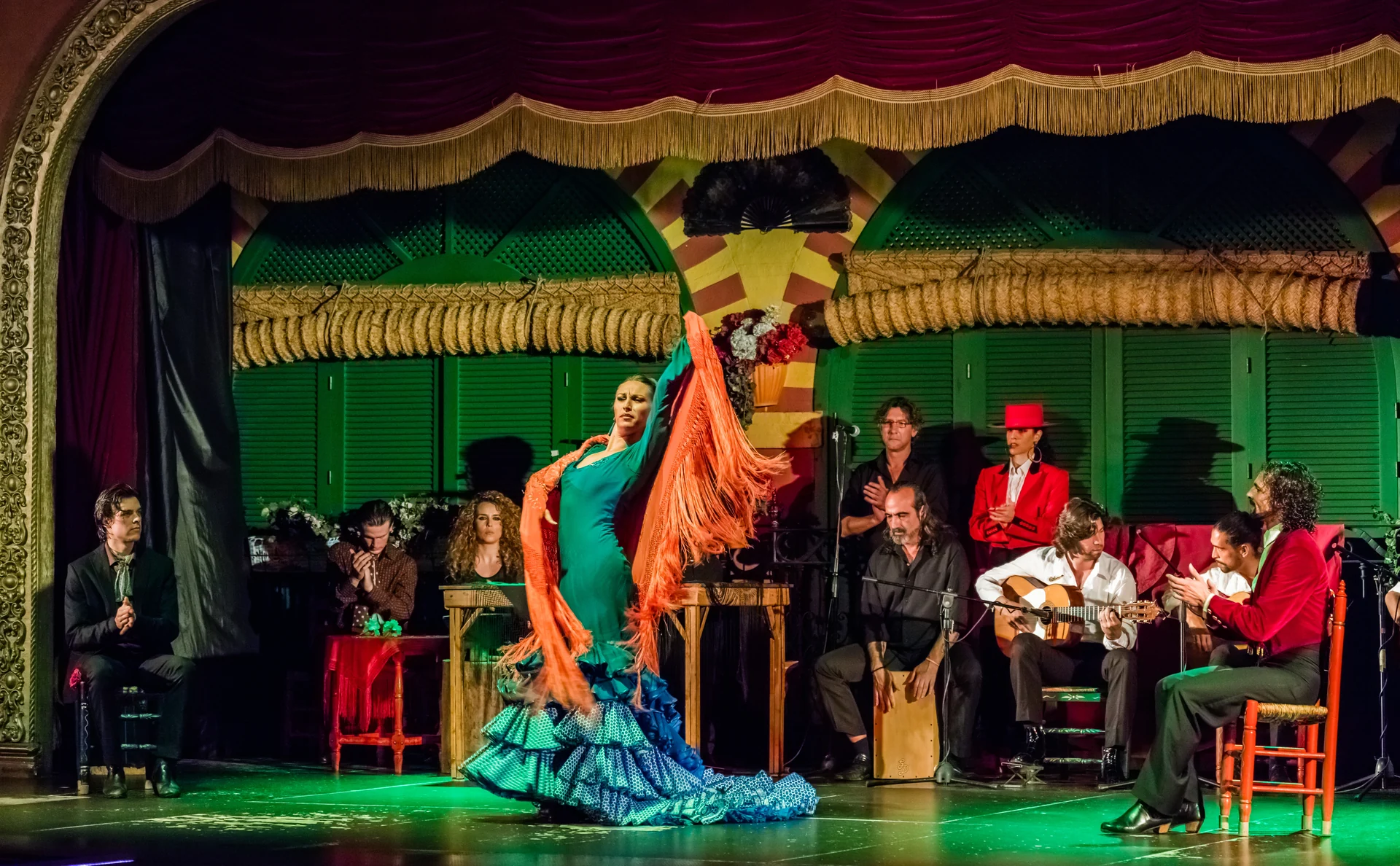
Begin with the people on stage
At a flamenco show, give yourself a moment to look beyond the dancer. Who is singing? Who is playing guitar? Who is keeping time with their hands? Your attention can move between them. A striking passage may belong to the voice, a quieter exchange to the guitar, and the next change of energy to the feet. You do not need to choose a favourite part immediately.
UNESCO inscribed flamenco on its Representative List of the Intangible Cultural Heritage of Humanity in 2010. Its account places Andalusia at the heart of the tradition, also recognising roots elsewhere and the essential contribution of Gitano communities. This is a living cultural practice carried by people, families and associations. The listing gives context to the art; it does not certify the quality of an individual ticketed show.
Cante, baile and toque
Cante means singing, baile means dance, and toque refers to instrumental playing, particularly the guitar. These words are useful when reading a programme. A cante recital may centre on a singer; a guitar concert may give the instrument the leading role; a dance production may have its own choreographic idea. A performance does not have to give equal space to all three to offer a meaningful encounter with flamenco.
During your first show, try following one performer for a short stretch, then widen your attention to the group. Notice when the singer begins, when the dancer leaves room for the voice, and how the guitarist responds. This is a way of observing, rather than a test of your knowledge. You can enjoy a song before understanding its words, while recognising that a translation would add another layer.
Compás: Listen for the shared pulse
Compás is a central word in flamenco rhythm. For a newcomer, think of it as the rhythmic framework that helps performers work together. Different styles can use different patterns, and some passages allow greater rhythmic freedom. There is no single beat you must master before entering a venue. Counting every sound can distract you from the performance you came to hear.
Instead, notice repetition, accents and pauses. Hand claps are called palmas, and footwork can contribute to the musical conversation as well as to the visual one. Watch for a moment when several performers arrive together after a build-up. You may sense the coordination even if you cannot explain it. Leave audience clapping to an invitation: Joining an unfamiliar pattern can interfere with what the performers are doing.
A style is different from a setting
You will encounter the word palo for a flamenco style or family of forms. Programme notes and recording credits can help you discover names gradually. Resist the pressure to memorise a long list on your first evening. Start with one name you hear or read, then explore an example later. A useful question is how the mood, pace and relationship between performers change across the programme.
A tablao, theatre, peña or Sacromonte cave tells you something about the setting and organisation of an event. It does not tell you everything about the music. Compare the actual programme, performers and ticket conditions. A museum visit can offer another route into the subject: Seville's Museo del Baile Flamenco combines interpretation with a published offer of performances, giving travellers a place to connect cultural background with a live encounter.
Make a small, personal starting point
Before travelling, choose a short recording from an authorised source and read its credits. Paco de Lucía offers a route into guitar; Camarón de la Isla into historical cante; Sara Baras into dance productions; Miguel Poveda into contemporary singing. These are starting points in our artist guides, not a ranking of everyone who matters. Let a question guide you: What draws your attention, and what would you like to hear in person?
After the show, jot down the venue, date and any artist names you can confirm. Separate your own impressions from what the programme promised. You might remember a vocal phrase, the closeness of the room or the dialogue between guitar and dance. That is a better foundation for learning than a claim that one evening represented all flamenco. Our first-show guide turns this introduction into practical steps for choosing and attending a performance.
Questions before you go
Do I need to understand Spanish?
You can enjoy the music and movement without Spanish. Understanding the sung words adds context; check whether a particular event offers introductions or programme notes in English.
Does every flamenco show include dance?
No. Read the programme: Some events focus on singing or guitar, while others are dance productions or mixed ensembles.
Is UNESCO recognition a recommendation for a venue?
The inscription concerns flamenco as intangible cultural heritage. It is not a rating or endorsement of a particular commercial show.
Books to deepen your understanding
Continue beyond the first performance with a little history, vocabulary and cultural context. These selections offer different ways into the art.
This section contains affiliate links. As an Amazon Associate I earn from qualifying purchases.
Flamenco – All You Wanted to Know
Emma Martinez
Explore cante and the role of the guitar, with English translations of lyrics and a glossary of flamenco terms. This book focuses on singing and guitar rather than dance.
Publisher detailsFlamenco: Gypsy Dance and Music from Andalusia
Claus Schreiner (editor)
A collection of essays on flamenco’s history and cultural setting. A route into the traditions behind the singing, dance and guitar you encounter on stage.
Publisher detailsCheck the edition, language, format and delivery options on Amazon before buying.