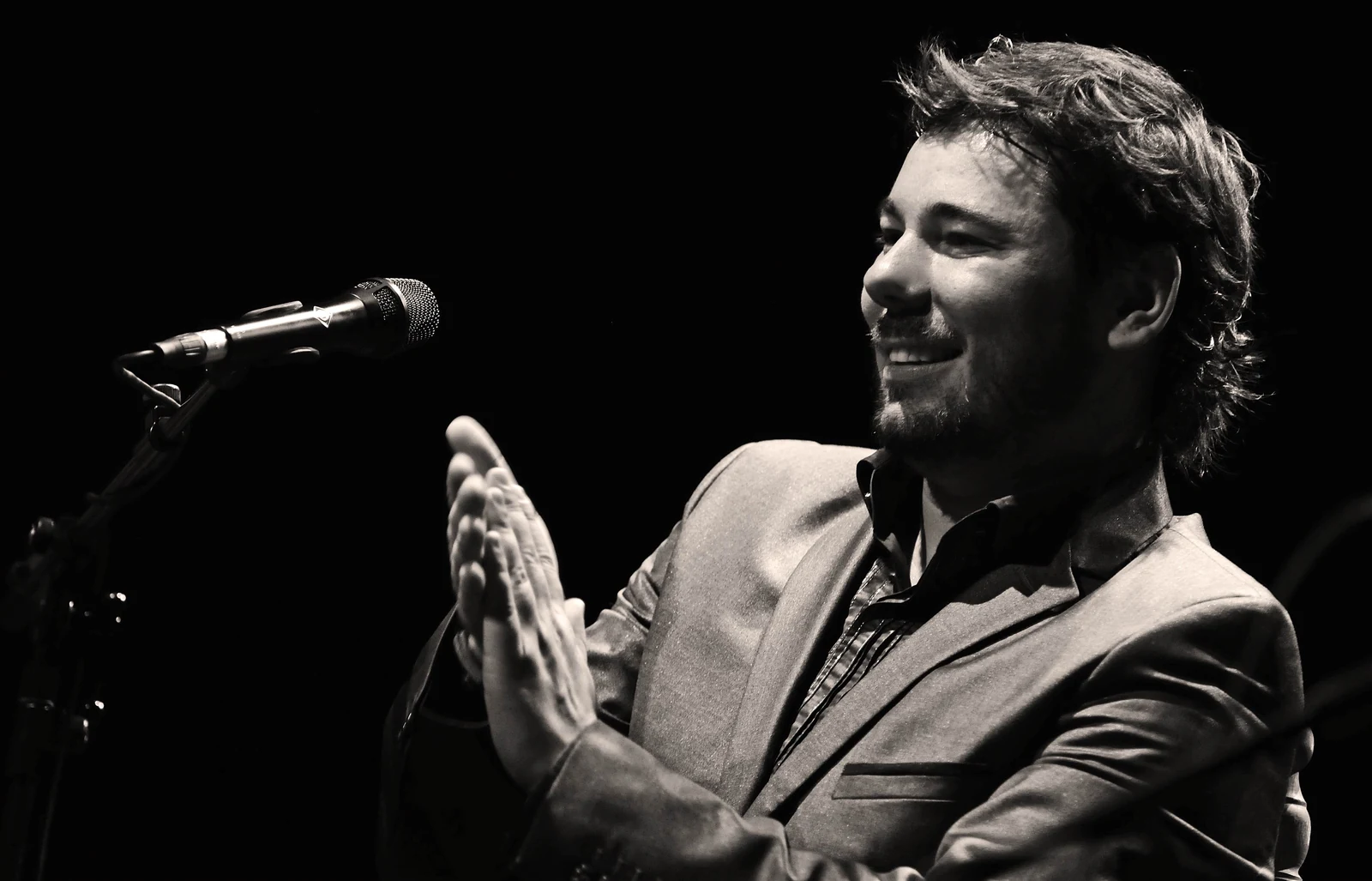
A singer whose story begins near Barcelona
Born in 1973, Miguel Poveda grew into singing through the musical life of Badalona, near Barcelona. His early professional experience included local tablaos. That beginning widens the geographical picture of flamenco for a visitor: Andalusia is central to the tradition, while artists, families and audiences have also developed its life elsewhere in Spain.
Poveda is a cantaor whose repertoire also reaches into copla and other musical settings. He has described a childhood listening environment of popular Spanish song and rock. His later variety reflects a developing musical curiosity, rather than a career confined to one programme.
The competition that opened a path
In 1993 he won four awards at the Festival del Cante de las Minas in La Unión. The result brought a decisive early recognition beyond his local beginnings. A later landmark was the 2013 concert at Madrid's Las Ventas, marking twenty-five years of his career. These moments place a festival breakthrough and a large retrospective celebration on the same trajectory.
The people he worked with helped widen that path. His account to RTVE names figures such as Enrique Morente and Juan Habichuela in his exploration of singing in Catalan. The connection is illuminating: Artistic development can involve learning from flamenco elders while opening another linguistic door. His biography gives space to both apprenticeship and encounters across musical communities.
A musical identity built around the voice
His work distinguishes a singer's identity from a single genre label. Cante remains central, while copla, collaborations and poetry create further settings for the voice. An evening may be a flamenco recital, a recording brought to the stage or a theatrical project with a literary starting point.
For an English-speaking visitor, that literary strand deserves attention before every word becomes clear. A phrase, a pause and the relationship with the guitar are parts of the encounter. A poem's context adds another dimension. His Lorca projects offer a route between those musical and literary interests.
Poema del Cante Jondo: A recording with Lorca
The 2024 album Poema del Cante Jondo, made with guitarist Jesús Guerrero, brings Lorca's poetry into a recorded musical project. Its twelve tracks give the listener a manageable sequence of separate pieces. The title points towards cante jondo, the deep-song world that fascinated Lorca, while the collaboration places a contemporary singer and guitarist in dialogue with his writing.
Try Ay, identified as a caña, alongside Encuentro, identified as tangos. Two pieces are enough for an initial session: Let the change of musical form draw your attention to the way a text is carried. Follow the voice first, then the guitar's part in the phrase. Returning to the poems afterwards can deepen a connection that began through sound.
Federico y el cante: Poetry becomes a stage journey
Federico y el cante appeared in the 2024 Bienal de Flamenco de Sevilla programme. It is a stage project, distinct from the album. The official programme follows Lorca's relationship with cante and figures including Silverio Franconetti, Manuel Torre and Pastora Pavón. Guitarist Jesús Guerrero is part of the production, connecting this theatrical journey with the recording partnership.
The programme ranges through styles such as seguiriyas, cantiñas and soleares. Those references place Lorca within a history of singers and musical forms, rather than presenting poetry as something added from outside. Reading about this production can enrich a visit to Seville or an interest in Granada's literary world, even when a different performance is on the current calendar.
Meeting an active artist on the road
Poveda continues to perform, and his official website provides concert announcements. Use the event's production title to connect what you have explored with what is actually being presented. A recital of cante and a Lorca-based project offer different starting points, even with the same singer at their centre. The published programme helps you choose the encounter that interests you.
His biography suggests a wider map: Badalona for the beginnings, La Unión for early recognition and Seville for a theatrical project. Carrying those places in mind gives a concert more context and shows how one flamenco career can belong to several parts of Spain.
Questions before you go
Does Miguel Poveda perform only flamenco?
Cante is central to his career, alongside copla, collaborations and projects built around poetry.
Where can I find his concerts?
His official website publishes concert announcements, with the relevant event providing details of the programme and tickets.